Showing posts with label Suppliers and products. Show all posts

Thursday, 22 January 2015

Visiting a Major Cider Producer

"Escanciando" or pouring cider from the vat for everyone to try
With the idea of finding new activities and experiences for our guests to enjoy whilst staying at the hotel, we’ve started visiting a lot of different places so as to be able to recommend what’s available and what each guest might enjoy best.

Cider made from 100% asturian apples
Asturias is famous for its cider; the region’s major drink. For people who want to see how it’s made traditionally we always recommend them to visit the Ruta del Sidra y Queso, a fabulous two hour tour talking about cheese and cider followed by an excellent lunch.

Walking round the instalations at Sidreria Cortina
The original wooden presses in the background have now all been replaced by hydraulic presses.
But it’s also possible to visit a larger scale producer of cider and taste the cider straight out of the vat. Last week we visited Sidrería Cortina in Villaviciosa, they are well organized and we had an interesting tour. After the tour it’s possible to have an excellent menu of the day in their restaurant next door.

Pouring cider from the vat
Explaining why asturian cider has to be drunk as soon as it is poured.
Visits to Sidreria Cortina are on a daily basis in July and August and twice a week the rest of the year. 

The original wooden Vats


Look out for our new information sheets at the hotel with all sorts of exciting activities and experiences waiting for our guests to enjoy

Tuesday, 8 April 2014

Pigs and more; the story of our free range pork.

Free range pigs rooting around in the wild
Ponga is a very little known mountain range directly west of The Picos de Europa. It’s a beautiful rugged area which was declared a Natural Park a few years ago, and is home to the most important beech forest in the Iberian Peninsular. It’s probably one of the areas we most enjoy walking in and have gone there many times with guests and the family

Ponga; an amazing mixture of mountains, woodlands and traditional farming.
Many years ago I had a really lovely experience in this area when I discovered a group of ten large pigs lying in the shade of the beech trees close to a small mountain stream. They were cautious of us, but not frightened and we could see someone had been feeding them old pieces of bread. They got up, checked we had nothing for them to eat and then started rooting around in the ground and slowly trotted away. To see pigs in such a natural environment is a really lovely sight and since then we have spotted groups of pigs on various occasions in this area. I often wondered who looked after them and whose they were.

The first group of pigs we saw in Ponga 
One day back in 2004 when we first started sourcing organic produce for the hotel I found myself in a large supermarket in Oviedo looking at long rows of pork chops in polystyrene packs. There were also a few odd packs of organic pork from Soria which is about 500 kms away. This made me decide to investigate what were the minimum conditions necessary for a pig to be certified organic. Obviously organic pigs have better conditions than their poor factory farmed counterparts but I was still surprised on some of the practices permitted and I didn’t really know what was going on at this farm 500kms away. I suddenly remembered the wonderful site of the pigs roaming freely in the forests and decided I would try and find out who owned them and if he ever sold them.

Our neighbour Victor 
I spoke about these pigs to our neighbour Old man Victor, who at that time was 73 years old and had been a farmer all his life. He knew there were farmers who still let the pigs run wild and fatten up on the beach nuts and chestnuts in the Ponga Mountains. It had been quite some years since he had been in that area and decided he would like to come with me to try and find the pig’s owner. We set of early one misty morning, he threw his small cigar away before he got in my car knowing I didn’t like cigarette smoke. We drove up the Beyos gorge and after talking to 3 or 4 local farmers in the area realised there were 2 farmers who raised these free range pigs. After a few more coffees in some rather pokey local bars we discovered who was one of these pig farmers and where he lived. Amador Crespo from San Jaun de Beleño.

Beech nuts on the forest floor in Ponga
We met him at his house at lunch time, he had just come down from the high mountain pastures where he had his cows grazing, he was quite a small person and very open. He told us he had up to 30 pigs grazing in the forests from late spring to autumn. Most of them were already pre-ordered by local people, being fattened up ready for “San Martin” the sacred dates when sausages would be made. He had a few extra pigs and so I said I would be interested in 2 of them and arranged to speak with him 3 months latter in October to arrange the best time to get them.

Autumn colours of the beech trees in Ponga
October came and the pigs were ready. Amador’s son has a lorry and so transported them to the slaughter house in Mieres where we went to supervise the jointing of them. No money was paid to Amador till after we had the pigs delivered from the slaughter house to the hotel and we knew their weight. We told Amador the weight of the pigs and then paid the agreed price per kilo for the whole pig. It all worked on trust.

Cows enjoying the magical mountain pastures in Ponga
Over the years I visited Amador various times and got to know how he operated. He often talked to me about some of the farming problems; wolves being the major problem with his animals which were running free in the mountains. I learnt that if the snow line came down in the autumn the pigs would come down from the mountain forests to the town where they would run around in the streets or shelter in some of his old stone stables. When they couldn’t graze and feed in the wild (because of the snow) he would feed them on a mixture of cereals, mostly barley and maize. He didn’t use organic cereal and certainly wouldn’t be bothered with all the bureaucracy that would be necessary to certify his pork organic, but for me he worked so well with nature he certainly had my vote of confidence.

 Abandoned village in Ponga
Very sadly he died in the spring of 2008 and at first no one in his family wanted to carry on his work. It seemed like it would be the loss of another traditional hill farmer. Then his son Marcos decided to give up his factory job and return to the family home to carry on farming like his father had always done. Each year we still get a couple of pigs from Marcos and although they are not certified organic we are more than happy with the way they are produced. We consider ourselves very lucky being able to spend the time needed to discover and get to know our suppliers. This first hand knowledge about our suppliers is very importante to us. Obviously you can’t visit all the suppliers of the products you consume so that’s when we rely on other forms of guarantee or certification normally an organic certification.

Beech forest in spring
Sausage the lesson for the global trade.

Buying whole pigs direct from the farmer has made us realise other things. There was a time when the hotel first opened (17 years ago) when we always served pork tenderloins in the restaurant normally with a prune and Malaga wine sauce. However when we started buying the pigs direct from the farmer out of the 200kgs of pork meat from the 2 pigs we brought there were only 4 x 1 kg tenderloins! So what about the rest of the meat.

Our pork sausages made from the free range pork
One of the most popular dishes Joe developed was sausages based on a Danish recipe for “frikadelas” By mincing some of the poorer cuts she produces this lovely dish served with a mild mustard sauce. Cooking for a slower life also means learning how to use all the different cuts of meat of an animal, so as to reduce the global movement of specific meat cuts, from one country to another.

Friday, 18 March 2011

Aroa Bodegas (Wineries)


Some of the Aroa vineyards with the new bodega on the hill in the distance.

In the season of 2004 we started incorporating organic wines in our wine list and one year later (after trying lots of different wines) we had a wine list made up exclusively of Spanish organic wines. In the beginning we had about 30 different organic wines on our wine list but over the years we have carefully selected about 20 of our most favourite wines to offer our guests

A recently pruned vine getting ready to send out its shoots for this season.

With out doubt one of our most favourite bodegas right from the beginning has been Bodegas Aroa. They have a philosophy of wanting to produce top quality wines and fully believe the best way to do this is by producing them organically. As we like to try and visit as many of our suppliers as possible we thought it time we visited Bodegas Aroa particularly as they had recently inaugurated new installations ready for this years grape harvest.

The recently finished bodega at Aroa

So on Wednesday we spent the day visiting the vineyards and wineries in the company of Txus and Kepa two of the key people behind the project. Bodegas Aroa started producing wine15 years ago from vineyards in the north of Navarra, an area which has been very famous for its wines for a long time. Over the following years they have planted more vineyards and now have about 20 hectares from which they will be producing about 120,000 bottles a year when the vines are all mature.

Kepa explaining about organic practices in the vineyard

They like us believe in the importance of caring for the soil in order to produce healthy crops. When they have to use a tractor they only ever pass it down alternate rows of vines so as to reduce soil compaction. The pruning’s and grass which grows in between the vines is cut and allowed to rot in situ so as to return natural organic matter back to the soil. Most of the crop treatments are based on plant extracts such as horsetail or stinging nettles and the vines are trained in such away so as to create a healthy environment around the grapes and thus reduce the possibility of disease entering. Their objective is not to produce lots of kilos of grapes but to produce top quality grapes so as to be able to produce top quality wines.

Testing different barrels of wine.

Up until this year Bodegas Aroa elaborated their wines in a neighbouring organic winery but after many years of planning they started building their own installations just over a year ago. One of their objectives is to be able to sell about 25% of their production locally, from the bodega itself. In order to do this they wanted to build a bodega people would want to come and visit, and they have certainly achieved that.

10,000 litre stainless steel deposits where the wine ferments.

Joe and Txus sampling wine from the barrel

The bodega consists of 4 stories; the lower two where the wine is elaborated is built under the ground and the upper two house the offices and restaurant. As it is situated on a slight hill there are stunning views of the surrounding valleys and mountains and most of their vineyards can be seen from the new bodega. The attention to detail in the design of the new bodega, the elaboration of the wines and the growing of the grapes is really impressive and it’s no wonder they produce such top quality wines.

The restaurante at Bodegas Aroa

In the hotel we stock four of their wines; a young Tempranillo Mutiko, a crianza Jauna, a reserve Gorena and a rosé made from grapes of Garnacha Tinto.

Aroa wine ready to be drunk in the hotel dining room

Bodegas Aroas is situated near the village of Estella in the province of Navarra and is just under a 5 hour drive from the hotel. The installation are open to visitors but it is necessary to make a booking first as it is to eat in the restaurant.

We wish them a long and successful business and thank them for such interesting day. More information on Aroa wines.

Saturday, 29 January 2011

Working with our wool


A lovely hand made felt bag from our Xalda wool

We have had our flock of sheep for fifteen years now and when it comes to shearing time we always end up with a big pile of lovely wool. For many years it got put in sacks, stored for a while, but eventually ended up in the rubbish bin. What a crime I always thought, but there is no market for sheep’s wool, synthetic fibres have done away with that.

Sheep shearing; the start of the process.

So over the last three years we started looking more seriously as to what we could do with our wool. One of the easier options was to use it for insulation, but this always seemed a shame, there must be a better way to use such lovely coloured wool.

So we contacted different artisans who work with wool and sent them samples of our Xalda wool. (Frances Baker from East Anglia was one.)After talking with them and receiving samples of their work using our wool we came to the conclusion felting would be the best choice for us to start with.

However we soon realised if we wanted this project to work the major problem was going to be trying to find someone local who wanted to work with the wool and could actually make a reasonable income from it. Then last November I got the chance to go on a day course in Cantabria with fifteen rural women from Eastern Asturias to look at preparing and spinning wool. Some of these women showed interest in working with our wool and there are now three local women who have started working with our wool to make different items to sell.

Washing wool in the village "lavadero"

Some of the fifteen women "picking" wool on the course in Cantabria

Our local women are working the wool in the traditional way and it’s a very labour intensive process. First the fleeces are hand washed either in a “lavadero” the old village communal washing points, or even in the river. After the wool has been dried it has to be “picked” or "teased" which is the process of opening up the locks of wool and removing any small seeds or bits. Once picked the wool is carded which is like combing the wool, before the felting process starts. We originally were carding the wool with hand held carders (which look like wire brushes) but this was very labour intensive and hand wound mechanical drum carders are available which can save a lot of time. So at the hotel we decided to buy a mechanical carder for use by any of the local women who wanted to so as to help reduce the time needed to prepare the wool.

Samathana using the drum carder at the hotel.

Jenny with samples of carded wool ready for felting

We are now slowly starting to see the results of all this work. One of the women, Jenny has made various felt bags and tried with other articles such as slippers, purses and hot water bottle holders. Its early days but with luck we will soon have a range of lovely hand made articles for sale at the hotel all made from our own organic sheep wool.

A variety of felted bags made by Jenny from our wool

Friday, 18 December 2009

Slow Food

Last weekend was the slow food exhibition in Bilbao “Algusto”, so it seemed a good opportunity to write a little about the slow food movement, slow food in Asturias and what we do on the farm and hotel with respect to slow food.

Slow food was founded in 1989 to counteract fast food and the disappearance of local food traditions. It also tries to increase people’s interest in the food they eat, where it comes from, how it tastes and how our food choices affect the world around us. Today the Slow Food Association is a vast network of 100,000 members from 150 countries, grouped in local chapters called convivia, of which there is one in Asturias.
.

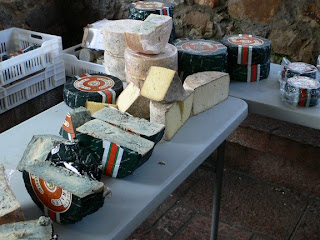
Local food traditions; Asturian cheeses

The Slow Food Foundation for Biodiversity builds the capacity of food producers and defends biodiversity and food traditions by creating new economic models that are being put in to practice around the world. The Ark of Taste is a catalogue of products in danger of extinction selected throughout the world by the slow food Association. Another initiative is the support of Presidia which are sustainable food production projects run by small producers of quality artisan products. Some of the Ark of Taste, and Presidia products were on display at the Algusto fair in Bilbao.

In Asturias there are four products which are in the Ark of Taste catalogue, they are; Asturian spelt, Xalda sheep, Natural Cider and Fresh Beans.

Selection of products made with spelt flour.

The Asturian spelt is a cereal sown during the winter since before the Romans. It requires special mills to remove the husk and produces an excellent, nutritive and flavoursome flour. It is used in breads and cakes and in the hotel we often make bread from organic Asturian spelt and serve it for breakfast or with the evening meal.

Xalda sheep on our farm

The Xalda sheep, indigenous to Asturias, is one of the oldest breeds of sheep in Spain. On the farm we have been breeding them for the last 12 years and regularly put Xalda lamb on the menu in the hotel restaurant. The meat is of excellent flavour and of a fibrous but tender texture.

Pouring natural cider.

Natural cider is the traditional drink in Asturias and has come to be a reference for the Asturian gastronomy. Apple plantations form a central part of the Asturian landscape reflecting the importance of cider in Asturias. On the farm we have 3 hectares of Asturian cider apples and although we do not make natural cider we make a natural apple juice. To try natural cider whilst in Asturias we recommend you visit a “chigre” (traditional cider bar.)

A selection of beans for sale at the Colunga local bean fair.

The fourth Asturian Ark of Taste “Fresh Beans” is a minority product at the moment. Its major difference with the traditional dried bean is that the beans are picked before they start drying. Beans are an integral part of the Asturian diet and there are many different types which are grown and sold in the region. There are various specialist been markets celebrated in Asturias throughout the year. At the hotel we grow different types of dried been and regularly incorporate them in the food we serve in the restaurant.


In the hotel restaurant; Xalda lamb with Canela beans and Mangetout, all produced on the hotel farm and waiting to be eaten!

More information on slow food
More information on the food we serve in the hotel
More information on Xalda sheep

Saturday, 11 July 2009

The food we serve

Catalan tartlet a vegetarian dish with tomatoes, courgettes, onions, capers, raisons and egg.

Last year, we conducted a study of the food that we serve in the hotel, as eaten by our guests for breakfast and evening meal. We wanted to know, in percentages by weight, how much of the food is produced by ourselves, and where the rest of it comes from. It was very pleasing to find that about 30% of the food is produced on the hotel farm. Over 15% of the rest is bought directly from certified-organic local small producers. We bake all our own bread, cakes and desserts from basic ingredients, representing another 20% of the food consumed. We buy about 30% overall from a specialist organic distributor. It’s also worth mentioning that over 98% of all the products used in the hotel restaurant are certified organic.

Freshly baked bread
.
But what does this mean?
When 30% of the food we use is produced by ourselves, that means a lot of fresh food, so a lot of preparation time in the kitchen – scrubbing, peeling and cutting vegetables and fruit – no ready-prepared packs just waiting to be opened and cooked. It also means the cooking has to be adjusted to what is available and in season. Growing and farming are weather dependent, and however hard we try on the farm, we don’t always get a continual supply of the same food all through the period when the hotel is open. Most of the food is seasonal, and this means that the kitchen has to adapt to what is available from the farm at any particular time of year

Mangetoute peas in the vegetable garden waiting to be picked.

For example, in April there are normally lots of mangetoute peas, then broad-beans in May, an abundance of raspberries and strawberries in June, plenty of beetroots in July, courgettes from July to September, peppers in August, and so it goes on. And it’s not only the vegetables that are seasonal: the chickens lay lots of eggs as the day-length starts increasing in March and April; our lambs are at their best by July, having fattened up on the spring pastures; and then there is the apple harvest in October. True food is seasonal.


Sweet peppers harvested in late summer

Imaginitive cuisine.
When I asked Joe what she thought was the most characteristic thing about the hotel cuisine, she said it is cooking with what is available. This means making the best use of what we have in the vegetable garden at that moment (or what is available from other small producers, or the market, or wherever), and using imagination in the way the food is prepared.

Preparing a "salpicon" salad in the kitchen

Roulades are an excellent example of adapting the dish to what’s available. Roulades can be based on so many different ingredients – such as leaf-beet, leeks, or carrots for savoury roulades – or on soft-fruits for dessert roulades, such as raspberries or strawberries. And when you get a glut of beetroot, for example, it can be roasted with cheese as a vegetable to accompany the main course, or used to make soup, or served in a salad with an orange mayonnaise, or served marinated in honey – and of course in a roulade. It’s all about imagination and creativity, and Joe certainly has those when it comes to food.

Fresh soft fruit dessert

The result is a tasty, varied and healthy cuisine, using lots of fresh produce. It’s often only a couple of hours from the time the food is picked to the time it’s served on your plate.

Picking raspberries in the afternoon ready for the evenings desserts

Local products and varieties.
Is the food we serve typically Spanish? Probably not. But because of our belief in using local varieties and races, the food we serve is based on a lot of genuine Asturian products. We often grow local varieties, and even produce the seeds of some of them so as to help maintain those varieties, as is the case with our onions, dried beans, and maize. Our apples are all Asturian cider-apple varieties. Our lamb is the indigenous Asturian race the “xalda”, now recognized by the slow food movement. Our beef comes from another indigenous breed, the “casin”, or Asturian mountain cow, which we buy direct from a young organic farmer called Angel Merino. Angel grazes his cattle on the Sueve Mountain range just 5 kms from the hotel. We buy a whole cow, which gets sent to the slaughter-house, and then we go to the cutting-house to supervise how it is cut for us and to help pack it. We then have a whole cow, with lots of different cuts of meat, and imagination is needed again to think of ways to prepare the different cuts. Maybe we will serve fillets with a mild “Cabrales” sauce (Cabrales is a local blue cheese), or a stew with peppers and tomatoes, or maybe we will make sausages and serve them with caramelized onions (onions from the vegetable garden of course, and from a variety which has been saved in the village for 40 years now!).

The farm with the Asturian xalda sheep grazing in the orchard planted with Asturian cider apples

One thing is sure – a lot of work, time and effort are put into sourcing, growing, preparing, and cooking the food that we serve in the hotel restaurant. However, to serve food which not only tastes good and is healthy, but embraces our beliefs, respects the environment, and supports local communities, is a reward in itself for us, and hopefully for our guests too.

Welcome

Hotel Posada del Valle is a small hotel in Asturias Northern Spain surrounded by its own organic farm and where we are passionate about organic farming, food, and sustainable livelihoods. In this Blog those of us who live and work at Hotel Posada del Valle open a door to share with all of you who are interested in what we are doing.