Thursday, 14 January 2010

Lots of snow!


Like many places we have just had more snow at the hotel than has been known for many years. The notable difference this year was the low altitudes at which it has been snowing. It started snowing last Friday and by Sunday there was 15cms of snow covering the farm. It started melting on the Tuesday evening and today Thursday it’s all gone from the farm, but still remains on the mountains.

In the 15 years we have been living here this is the first time we have had the farm covered with snow for more than a day, five days to be precise. The following photos were taken on the farm and on walks straight from the hotel during these last few days.
.
The farms behind the hotel
.
Walking on the small road behind the hotel with the Picos in the distance
.
The main road just before the Fitó looking point
.
Changing weather on the Sueve pastures.

At the top of the Sueve mountains

Just behind the village of Bodes close to the hotel

The vegetable garden under snow

Looking out from the sheep stable

Our chickens posing in the snow

The hotel!

Friday, 1 January 2010

Non-flying travel options


We got back from the UK yesterday where we had spent the Christmas celebrations with family. This time I travelled over to the UK by ferry and came back by train and bus so as to get first hand experience of the different non-flying options available for travelling to and from the hotel to the UK.

The last time I went to the UK by ferry I really enjoyed it, but was rather concerned about the crossing this time as gale force winds were blowing when I left. However the crossing was completely smooth and enjoyable (like the time before.) I took the ferry from Santander to Plymouth which takes about 24hours.


Brittany Ferries travels to both Plymouth and Portsmouth from Santander and P&O travels from Bilbao to Portsmouth. (The availability of the different destinations can vary according to the time of year.)


My reason for choosing a non-flying option was obviously for the lower carbon footprint, but I must say it really is a lovely relaxing way to travel, and recommend people to consider this option. There are various restaurants, bars and a cinema on board and the possibility to go for a walk around the ship, relax and admire the sea views or try and spot dolphins and whales.


As the ferries were not operating for my return journey I travelled by train from London to the French Spanish border and then by bus to Llanes. I left London at 17.00h and was in Llanes at 14.00h the next day.


To do the journey by train first I took the Eurostar from London to Paris where I had to change station and then took an overnight sleeper train to Irun on the Spanish border. For the final part of the journey I went by bus from Irun to Llanes (it is possible to get to Arriondas by the same bus.) There are many more trains and buses covering this route so it is possible to do the entire train journey during the day and the bus journey at night or the next day.


I got back to Spain ready to celebrate New Years Eve with the rest of the family and friends. Happy New Year!

Friday, 18 December 2009

Slow Food

Last weekend was the slow food exhibition in Bilbao “Algusto”, so it seemed a good opportunity to write a little about the slow food movement, slow food in Asturias and what we do on the farm and hotel with respect to slow food.

Slow food was founded in 1989 to counteract fast food and the disappearance of local food traditions. It also tries to increase people’s interest in the food they eat, where it comes from, how it tastes and how our food choices affect the world around us. Today the Slow Food Association is a vast network of 100,000 members from 150 countries, grouped in local chapters called convivia, of which there is one in Asturias.
.

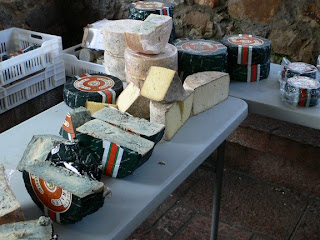
Local food traditions; Asturian cheeses

The Slow Food Foundation for Biodiversity builds the capacity of food producers and defends biodiversity and food traditions by creating new economic models that are being put in to practice around the world. The Ark of Taste is a catalogue of products in danger of extinction selected throughout the world by the slow food Association. Another initiative is the support of Presidia which are sustainable food production projects run by small producers of quality artisan products. Some of the Ark of Taste, and Presidia products were on display at the Algusto fair in Bilbao.

In Asturias there are four products which are in the Ark of Taste catalogue, they are; Asturian spelt, Xalda sheep, Natural Cider and Fresh Beans.

Selection of products made with spelt flour.

The Asturian spelt is a cereal sown during the winter since before the Romans. It requires special mills to remove the husk and produces an excellent, nutritive and flavoursome flour. It is used in breads and cakes and in the hotel we often make bread from organic Asturian spelt and serve it for breakfast or with the evening meal.

Xalda sheep on our farm

The Xalda sheep, indigenous to Asturias, is one of the oldest breeds of sheep in Spain. On the farm we have been breeding them for the last 12 years and regularly put Xalda lamb on the menu in the hotel restaurant. The meat is of excellent flavour and of a fibrous but tender texture.

Pouring natural cider.

Natural cider is the traditional drink in Asturias and has come to be a reference for the Asturian gastronomy. Apple plantations form a central part of the Asturian landscape reflecting the importance of cider in Asturias. On the farm we have 3 hectares of Asturian cider apples and although we do not make natural cider we make a natural apple juice. To try natural cider whilst in Asturias we recommend you visit a “chigre” (traditional cider bar.)

A selection of beans for sale at the Colunga local bean fair.

The fourth Asturian Ark of Taste “Fresh Beans” is a minority product at the moment. Its major difference with the traditional dried bean is that the beans are picked before they start drying. Beans are an integral part of the Asturian diet and there are many different types which are grown and sold in the region. There are various specialist been markets celebrated in Asturias throughout the year. At the hotel we grow different types of dried been and regularly incorporate them in the food we serve in the restaurant.


In the hotel restaurant; Xalda lamb with Canela beans and Mangetout, all produced on the hotel farm and waiting to be eaten!

More information on slow food
More information on the food we serve in the hotel
More information on Xalda sheep

Tuesday, 1 December 2009

Permaculture

Stone walling made from stones from the farm

The farm we run at Posada del Valle is a certified organic farm and has been for almost 10 years. However over the last couple of years as well as maintaining organic farming practices we have also been looking at the way we operate with a permaculture perspective.

Permaculture means different things to different people. A popular concept of permaculture is a system of gardening requiring little external inputs and the essence of permaculture is to work with what is already there.

The sheep shelter we built recently reflects this line of thinking, as we tried to use materials we already had on the farm. The basic structure is stone, of which we have abundance and is the natural building material of the area. For the beams we used wood from eucalyptus trees growing on the farm. The roof was made from old pallets which we got from our local builder (who was going to burn them) and finally we did buy some black plastic to cover the roof. This contrast completely with the first stable we built 12 years ago, made from iron beams, breeze blocks and corrugated iron roof!

The sheep shelter made from stone and wood from the farm

Another idea behind permaculture is to produce no waste, and to try and think in continual cycles. Compost is a classic example of this, making food from waste!

Kitchen waste on the compost, soon to produce food again.

This idea of producing no waste can be applied to many things; it just takes a little shift in mentality. Its often all too easy to buy something new to do the job when very often we can make do with something we already have.

An example is the eucalyptus trees we have growing on the edge of our farm. They are an invasive species which drain the soil of water and nutrients, making it difficult for other plants to grow. But rather than just cutting the trees down to burn in site we now try to cut the trees only when we have a use for them, either in construction or when we need fire wood. Rather than looking at them as a pest or waste we look at them as an asset.

Making the most of trees for fire wood

Another example is seed sowing compost. Being a horticulturist and realising the importance of seed sowing, I always like to buy some good sowing compost to sow my seeds in. The commercial sowing composts are normally peat based and not very sustainable. We now have an excellent substitute for the brought compost, from the farm; leaf mould: We have been making leaf mould on the farm for the last 2 years from all the leaves which blow around the hotel entrance. Around the hotel the leaves are seen as a mess and a waste, but we now look at them as a valuable material.

Cutting hay with a scythe for winter food for the sheep

But permaculture isn’t just a permanent (sustainable) agriculture; it has evolved to one of a permanent (sustainable) culture and to encompass all aspects of human habits.

If you are interested in permaculture you may be interested in the following books:
The Earth Care Manual by Patrick Whitefield
Permaculture, Principles and Pathways beyond Sustainability by David Holmgren

Sunday, 8 November 2009

The Annual Chestnut Fair in Arriondas

A selection of different varieties of chestnut on show at the fair.

This weekend was the annual chestnut fair in Arriondas which is celebrated along with a show of vegetables from local farmers and a wood fair. This is the major fair in Arriondas and originates from the importance and abundance of chestnuts at this time of year in the area.

Chestnuts for sale.

Farmers and village people would come along to this annual fair to sell the chestnuts they had collected and did not need for themselves. They would also bring any produce they had growing in their gardens at this time of year to try and sell with the chestnuts, hence the development of the vegetable show.
.
Seasonal vegetables on show

What is so lovely to see at the fair is the different number of varieties being produced by some of the local farmers. This biodiversity is typical of traditional small holders who grew, harvested and maintained seed of different varieties of maize, beans etc.
.
A lovely show of food biodiversity; beans and maize.
.
Different types of peppers, tomatoes, onions and pumpkins.
.
Nice to see the presence of one local organic producer
.
Over the seasons the local farmers acquired a lot of knowledge about the different varieties and their particular properties. This even applies to something like chestnuts where the exhibitors were proud to show the different types of chestnuts available.

Local knowledge; different varieties of Chestnut.
.
The wood fair is much more of a recent development and comes from the historical presence of various wooden furniture manufactures in Arriondas. Now there are only two small furniture manufactures left in Arriondas and the fair has become more orientated to the small artisan wood worker.
.
Local artisan carving wood

Artisan worker repairing a chair.

As in most local fiestas there was some traditional dancing and music and a good turn out of people despite the rainy weather.

Local dancing, costumes and music.

Although this event is celebrated when the hotel is shut there are a number of other traditional annual fairs celebrated in the area when the hotel is open. Some of the more popular ones are; the hazelnut fair in Infiesto, the apple fair in Villaviciosa, the bean fair in Colunga. There are also a lot of different cheese fairs celebrated throughout the year reflecting the huge diversity of cheese in the area.

Long live local cultures and diversity!

Thursday, 22 October 2009

Chamois

We have had lots of good weather this autumn and I’ve been able to make the most of it, doing some lovely high mountain walking in the Picos de Europa. On my walks I have had the chance to see a lot of chamois, which is probably the most representative fauna species of The Picos de Europa.


This amazingly agile animal is generally found above 1,500m and as a mountain dweller is very well adapted to living in the rugged, rocky landscape of the Picos de Europa.
.
A fully grown chamois reaches a height of about 75 cm and weighs about 50 kg. Both males and females have short horns which are slightly curled backwards. In summer, the chamois' fur has a rich brown colour which turns to a light grey in winter. Distinct characteristics are a white face with pronounced black stripes below the eyes, a white backside and a black dorsal strip. Chamois can reach an age of up to 20 years.
.
The hooves are thin and highly versatile, capable of running with extreme agility over difficult rocky terrain as well as snow and ice fields. This agility is due to the unique design of the cushions that occupy the central part of their hooves


Chamois are social animals that move in small groups in search of mountain pastures. These groups are formed only by males (which may be solitary) or only by females and their offspring, which only meet during the mating season.
.

Their sight, smell and hearing are excellent. This helps them quickly identify their predators, including bears, wolves, lynx and men. Other dangers to the chamois are avalanches, to the extent that it is not uncommon to find whole herds killed by avalanches at the time of thaw.

In the national park of The Picos de Europa there is an estimated population of about 5,000 individuals. Although they are active throughout the day the best time to see them is in the morning or early evening. One of the (relatively) easier walks where there is a good chance of seeing them is from Pan de Carmen near the lakes of Covadonga up to the Ordiales viewing point. (More information on this walk and others on the self guided walking section of our web page)

Walking up to the Ordiales view point with chamois admiring the views!

Monday, 12 October 2009

Apple Picking and Press Coverage

We started picking apples today and are expecting quite a large harvest this year (about 10 tonnes.) There were 6 of us picking and it will take about 15 days work to complete the harvest.

Interestingly enough this coincided with a news article about us on the BBC news web page:

"Looking out over their cider apple trees towards the Picos de Europa mountains beyond, Nigel and Joann Burch take a break from the harvest." To read the full article click on the following link:
BBC NEWS Spain's organic farmers dodge recession.

And for another interesting press coverage we had earlier the season in the National Geographic Adventure magazine you might like to look at this link: The New old Thing!

Its all publicity!

Welcome

Hotel Posada del Valle is a small hotel in Asturias Northern Spain surrounded by its own organic farm and where we are passionate about organic farming, food, and sustainable livelihoods. In this Blog those of us who live and work at Hotel Posada del Valle open a door to share with all of you who are interested in what we are doing.