Wednesday, 10 February 2010

Walks From The Hotel

Scenery whilst walking straight from the hotel to the Pico Moro

Over the years we have developed a number of walks which can be done starting straight from the hotel. These walks are ideal for guests who come with out a car or for those who just don’t want to worry about using their car. Just recently I’ve been doing some of these walks and checking the self guided walking notes we produce. Many of these walks go on tracks which are used and maintained by farmers so occasionally there can be changes, hence the need to revise the notes now and again.

Although you can’t get into the very high mountains (such as the Picos) walking straight from the hotel there are some very lovely walks you can do which still give you that mountain feeling as the photos show.
Up on the Sueve mountains (three weeks ago)

The Sueve mountain range just behind the hotel with its summit the Pico Pienzu (1050 m.) provides for stunning walking. Depending on your fitness level you can walk to the cross straight from the hotel or get a taxi (5.00 Euros) to the Fito viewing point (to save some of the climb) and then walk up to the cross and/or back to the hotel. This really is a lovely walk and one I do various times over the winter months.

The viewing point "El Mirador del Fito"
.

Looking towards the coast in the Sueve mountains (about a month ago)

Pico Moro is a lower mountain (556m) which also has a cross on its summit, and can be incorporated in to a circular walk starting directly from the hotel. There are fantastic views along the walk over the Sella valley and to all the surrounding mountain ranges.

Goats on Pico Moro

The summit of Pico Moro (last week)


.There are two shorter circular walks from the hotel “The Green Path” and the walk to the Santa Marina chapel. The Green Path takes you along a lovely path to the village of Pendas where there are excellent views over the River Sella and to the Picos de Europa. You can then walk down a small road into Arriondas or back to the hotel. The route to the Santa Marina Chapel takes you to an isolated chapel and then follows a small stream through woodland back to the hotel.

The woodland path back to the hotel from the Santa marina Chapel

Approaching Arriondas from the Green Path

A very popular and different walk is one from the village of Sevares to the hotel. Normally people walk along the green path in to Arriondas where they catch the narrow gauge railway to Sevares and then walk back to the hotel. This route takes you along quiet tracks and minor roads through small villages and delightful rural scenery. It also gives you a good insight in to the traditional farming life of the area.

Walking from Sevares to the Hotel on a frosty morning (a couple of days ago)

The working water mill close to the hotel (on the Sevares walk)

It’s also possible to walk from the hotel to the coast (Playa La Vega) along the Fito foothills. This walk takes about four and half hours so most people who do this walk return either by taxi or walk on into the coastal town of Ribadesella (another two hours walking) where it is possible to get a train or bus back to the hotel.

The Fito hills walking to the coast from the Hotel

The sea in sight whilst walking to Playa La Vega

Playa La Vega

There are also plenty of other walks which can be done using public transport which we haven’t mentioned in this blog entrance. However public transport isn’t always that frequent so train and bus times need to be checked first. We are also in the process of developing a couple of new walks which can be done straight from the hotel (but more on those soon.)

More rewarding scenery walking from the hotel; the cross on the summit of Pico Moro

So I’ll just carry on enjoying myself walking from the hotel, revising the walking notes to have them ready for when our guests come.

More information on the walks that can be done around the hotel

Monday, 1 February 2010

Lots of Lambs

Newly born lamb with its mother

Nature often follows cycles that in modern life we aren’t tuned in to. For example the sheep’s readiness for conception is related to both the lunar cycle and change in day length. This combination of cycles can give very precise results, as seen this year when 75% of our flock has given birth to their lambs in the last four days, so we now have 24 new born lambs running around the farm.
.

Group of Xalda sheep tuned in with nature.

We are particularly pleased to see all the lambs this year as the father is a new ram that was rather young at the time he was introduced to the flock.

The new young ram

Two young Xalda lambs (the new ram is their father.)

Last May we exchanged the old ram which had been with the flock for the last 4 years for this younger ram.

The old ram (photo taken 1 year ago)

Two lambs born July last year whose father was the old ram.

Normally we would only keep the same ram with the flock for a maximum of 2 years so as to prevent problems of inbreeding. However due to a variety of reasons we had not been able to change the old ram the two previous seasons, so despite being and excellent ram we were ready for him to go.

The meadow beneath the hotel being grazed by mothers with their lambs.

With in our flock of Xalda sheep (the Asturian indigenous breed of sheep) we want a diverse range of types as possible. We want to avoid selecting exclusively for one particular characteristic with the inherent danger of narrowing down the gene pool. With in the xalada race of sheep there are both white and black sheep, as well as black sheep with patches of white on their forehead. There are also sheep with slightly longer wool and sheep with different nose lengths etc. Then there are variations in characteristics which are not necessarily visible but also important, such as resistance to scrappy or tolerance to other diseases. We’ve made a decision that in our flock of traditional xalda sheep we want as much variation as possible. Variation and diversity means resilience, and for us that’s important.

Our flock with all different types of Xalda sheep and lambs just behind the hotel.

More information on Xalda sheep

Thursday, 14 January 2010

Lots of snow!


Like many places we have just had more snow at the hotel than has been known for many years. The notable difference this year was the low altitudes at which it has been snowing. It started snowing last Friday and by Sunday there was 15cms of snow covering the farm. It started melting on the Tuesday evening and today Thursday it’s all gone from the farm, but still remains on the mountains.

In the 15 years we have been living here this is the first time we have had the farm covered with snow for more than a day, five days to be precise. The following photos were taken on the farm and on walks straight from the hotel during these last few days.
.
The farms behind the hotel
.
Walking on the small road behind the hotel with the Picos in the distance
.
The main road just before the Fitó looking point
.
Changing weather on the Sueve pastures.

At the top of the Sueve mountains

Just behind the village of Bodes close to the hotel

The vegetable garden under snow

Looking out from the sheep stable

Our chickens posing in the snow

The hotel!

Friday, 1 January 2010

Non-flying travel options


We got back from the UK yesterday where we had spent the Christmas celebrations with family. This time I travelled over to the UK by ferry and came back by train and bus so as to get first hand experience of the different non-flying options available for travelling to and from the hotel to the UK.

The last time I went to the UK by ferry I really enjoyed it, but was rather concerned about the crossing this time as gale force winds were blowing when I left. However the crossing was completely smooth and enjoyable (like the time before.) I took the ferry from Santander to Plymouth which takes about 24hours.


Brittany Ferries travels to both Plymouth and Portsmouth from Santander and P&O travels from Bilbao to Portsmouth. (The availability of the different destinations can vary according to the time of year.)


My reason for choosing a non-flying option was obviously for the lower carbon footprint, but I must say it really is a lovely relaxing way to travel, and recommend people to consider this option. There are various restaurants, bars and a cinema on board and the possibility to go for a walk around the ship, relax and admire the sea views or try and spot dolphins and whales.


As the ferries were not operating for my return journey I travelled by train from London to the French Spanish border and then by bus to Llanes. I left London at 17.00h and was in Llanes at 14.00h the next day.


To do the journey by train first I took the Eurostar from London to Paris where I had to change station and then took an overnight sleeper train to Irun on the Spanish border. For the final part of the journey I went by bus from Irun to Llanes (it is possible to get to Arriondas by the same bus.) There are many more trains and buses covering this route so it is possible to do the entire train journey during the day and the bus journey at night or the next day.


I got back to Spain ready to celebrate New Years Eve with the rest of the family and friends. Happy New Year!

Friday, 18 December 2009

Slow Food

Last weekend was the slow food exhibition in Bilbao “Algusto”, so it seemed a good opportunity to write a little about the slow food movement, slow food in Asturias and what we do on the farm and hotel with respect to slow food.

Slow food was founded in 1989 to counteract fast food and the disappearance of local food traditions. It also tries to increase people’s interest in the food they eat, where it comes from, how it tastes and how our food choices affect the world around us. Today the Slow Food Association is a vast network of 100,000 members from 150 countries, grouped in local chapters called convivia, of which there is one in Asturias.
.

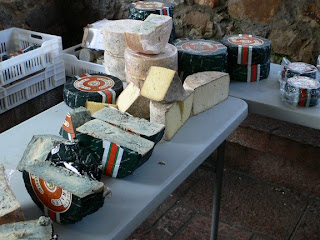
Local food traditions; Asturian cheeses

The Slow Food Foundation for Biodiversity builds the capacity of food producers and defends biodiversity and food traditions by creating new economic models that are being put in to practice around the world. The Ark of Taste is a catalogue of products in danger of extinction selected throughout the world by the slow food Association. Another initiative is the support of Presidia which are sustainable food production projects run by small producers of quality artisan products. Some of the Ark of Taste, and Presidia products were on display at the Algusto fair in Bilbao.

In Asturias there are four products which are in the Ark of Taste catalogue, they are; Asturian spelt, Xalda sheep, Natural Cider and Fresh Beans.

Selection of products made with spelt flour.

The Asturian spelt is a cereal sown during the winter since before the Romans. It requires special mills to remove the husk and produces an excellent, nutritive and flavoursome flour. It is used in breads and cakes and in the hotel we often make bread from organic Asturian spelt and serve it for breakfast or with the evening meal.

Xalda sheep on our farm

The Xalda sheep, indigenous to Asturias, is one of the oldest breeds of sheep in Spain. On the farm we have been breeding them for the last 12 years and regularly put Xalda lamb on the menu in the hotel restaurant. The meat is of excellent flavour and of a fibrous but tender texture.

Pouring natural cider.

Natural cider is the traditional drink in Asturias and has come to be a reference for the Asturian gastronomy. Apple plantations form a central part of the Asturian landscape reflecting the importance of cider in Asturias. On the farm we have 3 hectares of Asturian cider apples and although we do not make natural cider we make a natural apple juice. To try natural cider whilst in Asturias we recommend you visit a “chigre” (traditional cider bar.)

A selection of beans for sale at the Colunga local bean fair.

The fourth Asturian Ark of Taste “Fresh Beans” is a minority product at the moment. Its major difference with the traditional dried bean is that the beans are picked before they start drying. Beans are an integral part of the Asturian diet and there are many different types which are grown and sold in the region. There are various specialist been markets celebrated in Asturias throughout the year. At the hotel we grow different types of dried been and regularly incorporate them in the food we serve in the restaurant.


In the hotel restaurant; Xalda lamb with Canela beans and Mangetout, all produced on the hotel farm and waiting to be eaten!

More information on slow food
More information on the food we serve in the hotel
More information on Xalda sheep

Tuesday, 1 December 2009

Permaculture

Stone walling made from stones from the farm

The farm we run at Posada del Valle is a certified organic farm and has been for almost 10 years. However over the last couple of years as well as maintaining organic farming practices we have also been looking at the way we operate with a permaculture perspective.

Permaculture means different things to different people. A popular concept of permaculture is a system of gardening requiring little external inputs and the essence of permaculture is to work with what is already there.

The sheep shelter we built recently reflects this line of thinking, as we tried to use materials we already had on the farm. The basic structure is stone, of which we have abundance and is the natural building material of the area. For the beams we used wood from eucalyptus trees growing on the farm. The roof was made from old pallets which we got from our local builder (who was going to burn them) and finally we did buy some black plastic to cover the roof. This contrast completely with the first stable we built 12 years ago, made from iron beams, breeze blocks and corrugated iron roof!

The sheep shelter made from stone and wood from the farm

Another idea behind permaculture is to produce no waste, and to try and think in continual cycles. Compost is a classic example of this, making food from waste!

Kitchen waste on the compost, soon to produce food again.

This idea of producing no waste can be applied to many things; it just takes a little shift in mentality. Its often all too easy to buy something new to do the job when very often we can make do with something we already have.

An example is the eucalyptus trees we have growing on the edge of our farm. They are an invasive species which drain the soil of water and nutrients, making it difficult for other plants to grow. But rather than just cutting the trees down to burn in site we now try to cut the trees only when we have a use for them, either in construction or when we need fire wood. Rather than looking at them as a pest or waste we look at them as an asset.

Making the most of trees for fire wood

Another example is seed sowing compost. Being a horticulturist and realising the importance of seed sowing, I always like to buy some good sowing compost to sow my seeds in. The commercial sowing composts are normally peat based and not very sustainable. We now have an excellent substitute for the brought compost, from the farm; leaf mould: We have been making leaf mould on the farm for the last 2 years from all the leaves which blow around the hotel entrance. Around the hotel the leaves are seen as a mess and a waste, but we now look at them as a valuable material.

Cutting hay with a scythe for winter food for the sheep

But permaculture isn’t just a permanent (sustainable) agriculture; it has evolved to one of a permanent (sustainable) culture and to encompass all aspects of human habits.

If you are interested in permaculture you may be interested in the following books:
The Earth Care Manual by Patrick Whitefield
Permaculture, Principles and Pathways beyond Sustainability by David Holmgren

Welcome

Hotel Posada del Valle is a small hotel in Asturias Northern Spain surrounded by its own organic farm and where we are passionate about organic farming, food, and sustainable livelihoods. In this Blog those of us who live and work at Hotel Posada del Valle open a door to share with all of you who are interested in what we are doing.