Friday, 11 March 2011

Fruit and Nuts

Hazelnuts waiting to be harvested.

We’ve been enjoying a week of lovely sunny weather and I’ve been working a lot in the vegetable garden making sure there will be a good supply of fresh vegetables for when the first guests arrive. But its not just vegetables that we have been planting this winter, we’ve also planted a diverse range of fruit and nut trees.

Its an important part of our philosophy to produce in a sustainable way as much food as possible for the restaurant and to help achieve this we’ve been planting different types of fruit for many years now. Some types of fruit have been more successful than others and with time we are learning which fruit and which varieties are better adapted to our farm.

First shoots on the newly planted "Polka" raspberry bed.

Tempting fruits!

Raspberries have always been very successful with us producing abundant crops of tasty fruit and so this winter we planted a third raspberry bed with an autumn fruiting variety Polka which we had already trialled. In January we also planted a new strawberry bed to replace one we planted three years ago. After a couple of years strawberry plants start to age so now we replant a bed each year to keep production up and maintain a good supply of quality fruit. Not all our soft fruit has been successful; this year we grubbed our gooseberry bushes having been defeated by “sawfly” a nasty little fly which lays its eggs on the gooseberry leaves and whose lava leave the bush embarrassingly devoid of any foliage. This winter we also pulled out our blueberry trial. Our soil isn’t sufficiently acid and rather than getting a bumper harvest of juicy blueberries we only had some sickly yellow plants with no fruit, but that doesn’t put us of trialling new types of fruit!

Newly planted strawberry bed.

The major trial we have planted this year is kiwis. Asturias is a region which has quite a lot of kiwi plantations, particularly by rivers and in the warmer coastal area. We’ve planted two types of kiwis; the better known fuzzy kiwi and the smaller hardy kiwi. Both are sensitive to late frosts which may be a problem in our area and both are thirsty climbers and will need some form of irrigation. If all goes well the fuzzy kiwi will provide us with fruit over the winter and early spring when the hotel opens and the lesser known hardy kiwi will produce a smaller red fruit ripening in late summer.

Tender bursting bud of the fuzzy kiwi.

New shoots on the hardy kiwi.

Hazelnuts are an integral part of the Asturian landscape and have various uses. As well as producing nuts they are used for making “green” fences and they are also regularly coppiced to produce poles. A few years ago we planted a number of bushes on the edges of the meadows ready to make a living green fence, but this year we have planted some hazelnuts in the orchard with the principal idea of harvesting the nuts. This is assuming the badgers and wild boar don’t eat the nuts before we harvest them.

Hazlenut ready for copiceing

We have often been told by the local villagers that many years ago our farm abounded with walnut trees but sadly one of the previous owners brought the farm with the exclusive purpose of felling and selling the walnut wood. Luckily walnut trees seem very content with the shallow soil and limestone rock which predominates on our farm and the red squirrels have done an excellent job planting the walnuts and there are now mature walnut trees on the farm once again. To accompany these indigenous walnuts this winter we planted some grafted trees but I think it will be quite a few years before we get a chance to sample the nuts.
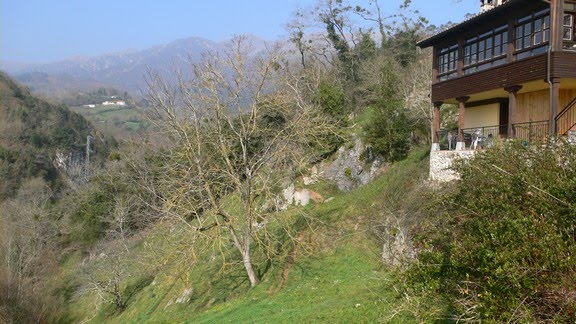
Mature indigenous walnut tree by the hotel.

Immature walnut fruit

Over the last two years we have lost quite a few apple trees from our orchard and this is most probably due to voles which relish on eating apple roots and the presence of a mystery fungal disease. So in the apple orchard we will leave some areas with out trees and in other parts we have replanted with different types of fruit trees including; Nashi, figs, plums, persimmon as well as the kiwis and hazelnuts. This will make the orchard more of a “patchwork” and with more edges which is always good for biodiversity. Hopefully some of these different fruit trees will adapt well in the orchard, be less attractive to the voles, and in years to come we and our guests will be able to sample their fruits and enjoy a more diverse orchard.

Plum trees in flower in the apple orchard!

Tuesday, 22 February 2011

Walking from the Hotel to Ribadesella

The bar at Terenes with its garden overlooking the coast, very suitable placed on this walk!

When the hotel is shut I spend quite a lot of time walking; sometimes exploring new peaks and other times revising and improving the self guided walking notes we have for our guests.

One of the popular walks with our guests is the walk from the hotel to La Vega beach along the Fito hills. This walk takes about four and half to five hours. Most guests then get a taxi from the beach back to the hotel but it’s also possible to walk on further from La Vega to Ribadesella. We hadn’t got the walking notes for the second part of this walk so on Saturday Joe and I checked out a couple of new foot paths on this route and wrote the notes for the second part of this walk.

The Fito hills with the sea in the distance

The first part of the walk from the hotel takes you up to the Fito hills and follows tracks with magnificent views all the way to the Berbes golf course before you walk down to the La Vega beach itself.

Woodland tracks on the walk

To walk on to Ribadesella from La Vaga beach takes about an hour and a half. First you go through the small hamlet of La Vega and then along a very small lane to Terenes. On route you have the possibilities (at low tide) of taking a minor detour to visit the dinosaur footprints at the bottom of the cliffs. This part of the Asturian coastline is known as the Jurassic Coast for the number of different places where you can see dinosaur foot prints. There are also a couple of well placed bars at Terenes one with an out door garden with lovely views over the coast.

Dinosaur footprints on the cliffs at Terenes

It’s not so far from Terenes to Ribadesella where you can enjoy the beach and promenade as well as the the river estuary and old town. From Ribadesella it’s possible to get the narrow gauge train back to Arriondas.

The river estuary at Ribadesella

This is one of the many walks that are possible to do from the hotel with out a car. There is much more information on the different walks in the area in the self guided walking section on our web page.

The Fito hills and morning mist

Saturday, 12 February 2011

Preparing the Vegetables

The greenhouse full of vegetable seedlings and plants.

Come April and we will open the hotel and the restaurant once again. That will mean lots of evening meals to prepare and lots of vegetables to pick clean and cook. Although we open in April, for our guests to be able to enjoy our freshly grown vegetables a lot of work and planning starts many months earlier in the greenhouse and on the vegetable plot.

"Cebolleta" or sweet onions, planted in October to be ready for the first guests in April

At this time of year we are particularly busy sowing and producing plants ready to plant out as soon as the danger of cold weather has passed away. We built the greenhouse last year with the idea that we could start sowing earlier, raise the plants in the protection of the greenhouse and produce larger plants which would come in to cropping sooner when planted outside.

Lettuce growing in the greehouse as well as strawberry plants

Now the greenhouse is bursting at the seams with small plants and seed trays as many different seeds start their cycle of life. Tomatoes, peppers and aubergines are some of the plants which take the longest to produce, sown in January they spend three month in the warmth of the greenhouse before planted out in late April. Other plants have a much shorter cycle such as lettuce, cabbages and spinach and these are ready to plant out in less than a month from sowing.

Lettuce planted outside in cloches for an even earlier harvest.

Oats growing in different vegetable plots as an overwinter cover crop.

This year we have also sown our midwinter sowing of mangetout and broad beans in the greenhouse. In previous years we have made all the sowings outside starting in mid October and finishing in mid February. However most years any peas and beans sown outside in mid winter soon get found by the mice which eat the seeds before they get a chance to germinate. So this year with the mice defeated we hope to be picking mangetout and broad beans for an even longer season

First flowers on the broad beans sown in October outside

Mangetout from an early November sowing starting to climb up their suports (hazzle twigs.)

It’s not just sowing and planting which has to be done at this time of year, the vegetable beds themselves have to be prepared. Many will have been sown with a ground cover crop of oats in the autumn so as to protect and nurture the soil over the winter months and prevent the valuable nutrients being leached from the soil by the winter rain. Before planting the beds the oats have to be pulled out by hand (and composted) leaving a lovely friable soil full of life. Other jobs include turning the compost, as well as weeding and mulching beds

Turning the compost.

Yes it certainly takes a lot of work to try and produce a steady supply of home grown vegetables for the hotel but it’s very rewarding seeing everything grow and in such a natural way in harmony with nature. Its also very rewarding seeing all the lovely food in the hotel restaurant prepared from these home grown vegetables and as for it eating it hmmmm.

Saturday, 29 January 2011

Working with our wool


A lovely hand made felt bag from our Xalda wool

We have had our flock of sheep for fifteen years now and when it comes to shearing time we always end up with a big pile of lovely wool. For many years it got put in sacks, stored for a while, but eventually ended up in the rubbish bin. What a crime I always thought, but there is no market for sheep’s wool, synthetic fibres have done away with that.

Sheep shearing; the start of the process.

So over the last three years we started looking more seriously as to what we could do with our wool. One of the easier options was to use it for insulation, but this always seemed a shame, there must be a better way to use such lovely coloured wool.

So we contacted different artisans who work with wool and sent them samples of our Xalda wool. (Frances Baker from East Anglia was one.)After talking with them and receiving samples of their work using our wool we came to the conclusion felting would be the best choice for us to start with.

However we soon realised if we wanted this project to work the major problem was going to be trying to find someone local who wanted to work with the wool and could actually make a reasonable income from it. Then last November I got the chance to go on a day course in Cantabria with fifteen rural women from Eastern Asturias to look at preparing and spinning wool. Some of these women showed interest in working with our wool and there are now three local women who have started working with our wool to make different items to sell.

Washing wool in the village "lavadero"

Some of the fifteen women "picking" wool on the course in Cantabria

Our local women are working the wool in the traditional way and it’s a very labour intensive process. First the fleeces are hand washed either in a “lavadero” the old village communal washing points, or even in the river. After the wool has been dried it has to be “picked” or "teased" which is the process of opening up the locks of wool and removing any small seeds or bits. Once picked the wool is carded which is like combing the wool, before the felting process starts. We originally were carding the wool with hand held carders (which look like wire brushes) but this was very labour intensive and hand wound mechanical drum carders are available which can save a lot of time. So at the hotel we decided to buy a mechanical carder for use by any of the local women who wanted to so as to help reduce the time needed to prepare the wool.

Samathana using the drum carder at the hotel.

Jenny with samples of carded wool ready for felting

We are now slowly starting to see the results of all this work. One of the women, Jenny has made various felt bags and tried with other articles such as slippers, purses and hot water bottle holders. Its early days but with luck we will soon have a range of lovely hand made articles for sale at the hotel all made from our own organic sheep wool.

A variety of felted bags made by Jenny from our wool

Monday, 17 January 2011

Lots of Lambs

Part of our flock of Xalda sheep.

It’s particularly lovely to walk around the farm at this time of year and watch the young lambs running backwards and forwards and jumping in the air whilst their anxious mums look on. We had a lot of lambs born in the last week of December and these lambs are now particularly active running from one end of the farm to the other in a very playful way.

Getting ready for play time

Our Xalda sheep (like most sheep of the northern hemisphere) breed in the autumn and winter months and are known as short day breeders. It is a survival advantage for the specie to give birth to their young during periods of favourable weather and feed supplies. In the valleys and coastal regions of Asturias by February the meadows are bursting with growth and this means plenty of food for the new lambs and the hungry mums.

White mother with her three day old lamb.

Brown mother with her three week old lamb.

Sheep do not need an uncomfortable talk from their parents or to watch a film in school about the birds and the bees. Influenced by a mix of environmental factors and hormonal responses sheep instinctively know what to do and when to do it.

The moon over the farm as seen from the hotel with the Picos in the distance.

In our flock we have the ram roaming with the ewes all year long unlike many “commercial” flocks where the ram will be introduced only for a short period of time so as to control the date of lambing. On our farm there is no controlled mating time and the natural cycles of the earth and the moon are left to assert their influences on the sheep’s reproductive cycles.

Dusk over the farm with the moon over the sheep.

On our farm where nature is left to her own course lambing certainly comes in flushes. A surge of lambs get born in a 5 to 7 day period and this occurs about every 4 weeks.

Some of our sheep with the hotel in the background.

Some people say that the lunar influence on the feminine biology does not have any demonstrated scientific base, and it is a belief consequence of millennia of cult difficult to overthrow. However when you work on the land and are truly in contact with nature, like on the farm at Posada del Valle, its difficult not to believe in lunar cycles and the wisdom of nature.

Newly born lamb with her caring mother.

Tuesday, 4 January 2011

The Colours of Asturias

Asturias is a land of many contrasts, a tapestry of rich and diverse landscapes that never fail to inspire. Sited on Spain’s Costa Verde, the Green Coast, Asturias celebrates its beauty by claiming to be a natural paradise.

The beach at "Cuevas del Mar"

Climbing above the clouds in the Picos de Europa

The Bay of Biscay’s water offers blue and aquamarine vistas edged with golden sands and pebble beaches. Summer brings expanses of clear blue sky with occasional visits from grey and silver clouds that carry rain to nourish and refresh. In its prime, the sea is bejewelled with white surf and spray that crashes into rocky shores and shifting yellow sands. Surfers glisten like grey seals carry boards emblazoned with vibrant and fluorescent shapes. There are many beaches to mention but Torimbia, Espasa, Vega and La Isla bring year round joy to young and old alike, fresh, energised air and water that helps you absorb the seascapes and gain inner calm.

The beach at Torimbia

Lobster pots at Ribadesella

The Costa Verde reflects its shades of green throughout its lush valleys, deciduous woodlands and evergreen forests. As autumn falls the greens fade to hues of yellow, chestnut, mahogany, orange and burnt umber as the cooler air and winter beckons. The woodlands open to reveal concealed views of grey limestone scree and platinum tinted mountains. Topped with crisp white snow that glistens in the golden winter sun, the slopes are punctuated by twisted evergreen oaks laid bear to the seasons. The mountains are majestic in their shape shifting as the sun casts shadow and changes shade. The Ponga woodlands, the Pesanca trail, the Picos de Europa and the Sueve mountains show with pride their palette of many colours.

Horses drinking from a stream in the foothills of the Picos

The high mountain peaks in the western massif

Irisis in the wood on the hotel farm

The meadows of Asturias present a riot of colour to attract flora, fauna and fungi that flourish in unique and pristine conditions. The seasons advance and rotate a rich colour wheel from red through to yellow, from blues towards violet and indigo. Dying flowers dry to sculptured, straw-coloured seed heads before being cut to help shed their seed to replenish the carpet of flowers for next year.

Wild flowers in the hotel meadows

Gorse in flower in the Ponga mountains

The Towns, Cities and Villages of Asturias offer a muted palette of life out of season with less hustle and bustle but always filled with the most colourful characters with endless stories to tell and pictures of life to paint. As holidays and vacation time approaches, the people of Asturias prepare to welcome new guests and old friends from vibrant lands further a field. With many opportunities for Asturian culture and customs to shine at fiesta time, generations gather to dress in richly coloured and decorated costumes and to dance and merry make to the rhythm of pipe and drum. The colours of the Asturian flag reflecting those of the sun and sky as it waves in the evening breeze and is paraded with pride by its kith and kin.

The sea town of Cudillero

The Sunday market at Cangas de Onis

The colours of Asturias paint many fond and lasting memories for someone like me who relocated here after using Posada del Valle as a base for several holidays and for all those who visit and take time to soak up the experience. Many return, eager to experience and remember more images from the Asturian land, sea and sky. For the artist, photographer, writer, poet, traveller or voyager, the colours of Asturias will truly inspire and prove its worth as a natural paradise.

Sunset over a sea of clouds above the Carres gorge.

Entrance written by Ian Hicken

Welcome

Hotel Posada del Valle is a small hotel in Asturias Northern Spain surrounded by its own organic farm and where we are passionate about organic farming, food, and sustainable livelihoods. In this Blog those of us who live and work at Hotel Posada del Valle open a door to share with all of you who are interested in what we are doing.